Tuesday, February 23, 2010
Monster Music Mix...for my Monsters!

Tuesday, January 12, 2010
Twenty Two Years Ago Today I Froze...
Almost twenty-two years ago, to the day at this exact time (9:30 pm), I was huddled under a snow-heavy willow tree seeking shelter from the vicious and incessant wind along Fossil Creek, deep in the White Mountains National Recreation Area. I was 15, and very, very cold…hypothermia had set in a couple hours earlier and I had passed the point of shivering. I couldn’t feel my hands, one of my feet had severe frostbite, and I had just about given up hope of getting warm. I was huddled therewith my father and we were both trying to keep each other sane and awake so that we would at least survive another hour until Dick Bouts came back on his snowmachine to carry us to the Windy Gap cabin where my younger brother Andy, hopefully, had a fire and warm sleeping bags waiting for us.

It was -45 degrees with a 20-25 mph wind and we had been in those conditions all day, trying to break trail with our snowmachines into the Windy Gap cabin. We had started at 10:00 in the morning, just as the sun broke the horizon and we had battled the elements all day, exhausting both our bodies and spirits. Around noon my snow machine had bogged down in a new patch of overflow on Wickersham Creek and, foolishly, I had stepped off the snowmachine to pull it onto more solid ice. I sunk in up to my knee and filled my right bunny boot with slush and water. I hated wet feet and the sloshing and squishing in my boot drove me crazy. By 2:00 pm we reached the Colorado Creek cabin where we intended to eat lunch and warm up before pushing on to the Windy Gap cabin for the night.

The Colorado Creek cabin is located next to a small kettle pond in a wide, windswept patch of tundra. As Andy and I broke out our peanut butter sandwiches, frozen stiff and solid, my Dad and Dick Bouts went out to find the woodpile for the cabin to light the woodstove. The plan was to eat lunch and allow me to dry out my boot and socks before proceeding to Windy Gap. In anticipation of the imminent warmth a fire would afford I took off my bunny boot and socks and put my cold foot in by parka to warm up. Just after I had removed my boot the adults returned with the devastating news that there was no wood to be found. To make things worse, the heavy snow over Christmas had buried all of the small black spruce that might have been cut for firewood in years with less snow. So, there I was with my wet, cold foot out in the -45 degree cabin, a pair of socks frozen stiff, and a bunny boot glazed inside and outside with ice. The next potential chance for warmth was 26 snowbound miles away at the Windy Gap cabin.
I had no choice but to don my frozen socks and boot. We all knew that the chances of my foot reheating the boot were next to none and we drove our snowmachines over the unbroken trail like bats out of hell in the hopes that the minutes we saved would lessen the inevitable damage to my foot, but we were stopped by deep snow and low gas almost 7 miles from the cabin. I remember sitting at the top of the ridge that dropped precipitously into the Fossil Creek drainage with 42 miles of trail behind us and 7 miles of unbroken powder ahead. We debated the pros and cons of going back or forging ahead and decided that our best bet lay in pushing on with one snowmachine to Windy Gap cabin to conserve gas. It was decided that my dad and I would scout and compact the trail with snowshoes down to Fossil Creek (almost 2 miles), Dick Bouts would follow our trail on an old BLM SkiDoo Tundra with Andy.
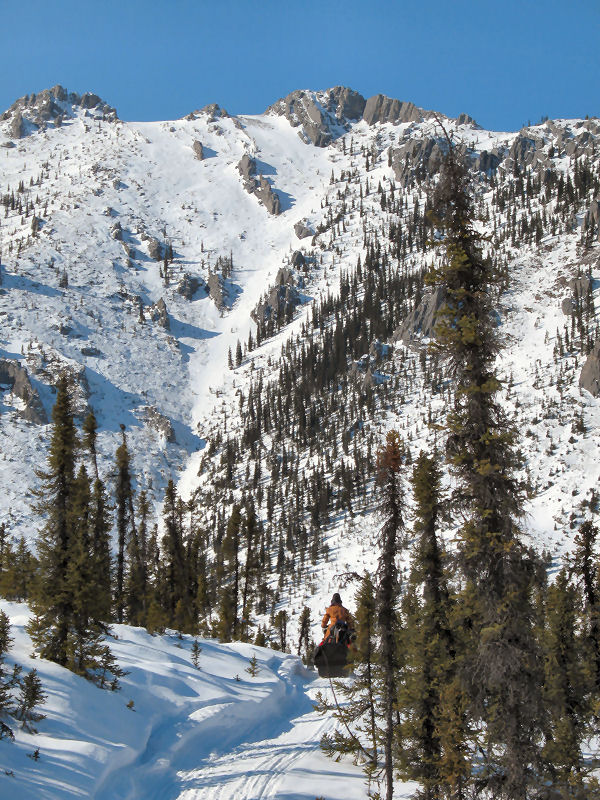
Once we got down to Fossil Creek, the overflow had created a smooth, new sheen of ice that Dick and Andy could follow without our help. It was decided that Dick and Andy would proceed to the Windy Gap cabin. Andy would remain at the cabin and get a fire started and Dick would then ferry my dad and I to the cabin, one by one, depending upon who was worse off. So, that’s why we found ourselves huddled beneath that small willow bower on a frigid January evening. I remember sitting there with my dad, the cold moonlight casting long shadows over the deep snow, straining our ears listening for the distant whine of the old Tundra coming back along the creek bed for us. I don’t remember much beyond this…neither does my dad.
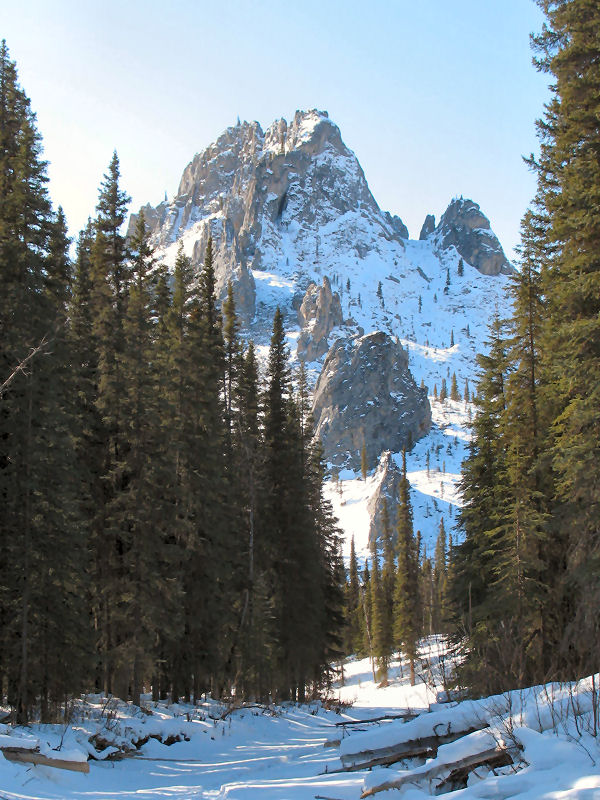
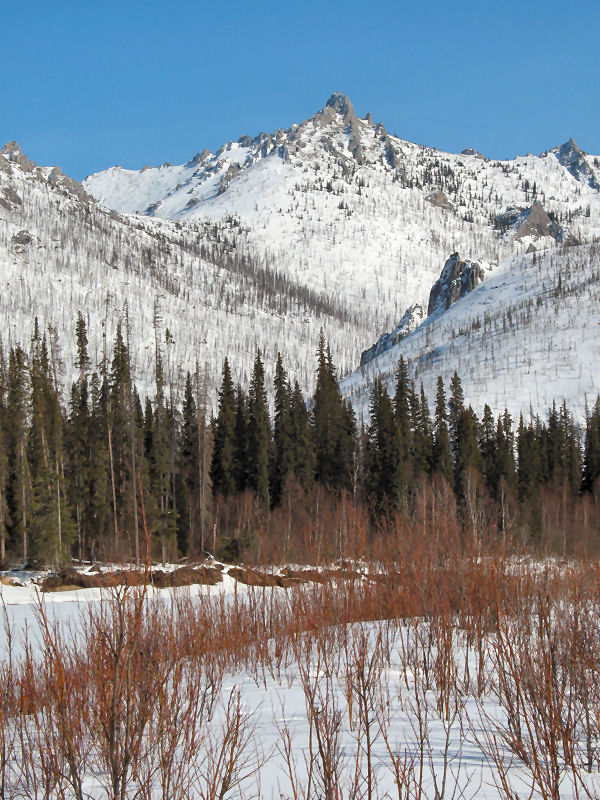
My father and I haven’t talked much of this evening and I remember very little beyond being in the cabin, lying on an old moth-eaten mattress next to the fire crying as my frozen foot slowly began to unthaw. I am certain that very few people have experienced the sensation of warm blood flowing back into a frozen appendage, bursting the frozen, damaged blood vessels as it goes. It’s and excruciating experience and results in significant tissue damage. I eventually fell asleep, or passed out…I can’t remember which, but awoke the next morning in Windy Gap cabin with a coating of ice over my sleeping bag and a right foot that was almost three times its normal size. Our initial plan had been to head back to the Elliot Highway that morning and get back to town, but it quickly became apparent that my swollen foot was not going to fit in my boot. So we decided to stay at Windy Gap.
We ended up staying at Windy Gap for 4 days. We lived off old cans of Dinty Moore beef stew left from the winter before and by rationing our snacks. We spent that days stoking the fire to keep the -40 temperatures at bay, playing cards, reading and rereading old Outdoor Life magazines, and telling each other stories and jokes. In the evening we’d look out to see the most spectacular array of stars and we’d try and identify the few constellations we knew. The distant howl of wolves were haunting and left an indelible impression on me; I recall not being scared, in fact it was comforting to know that there were other living creatures out in the cold and I felt reassured by the nightly chorus of the wolves.
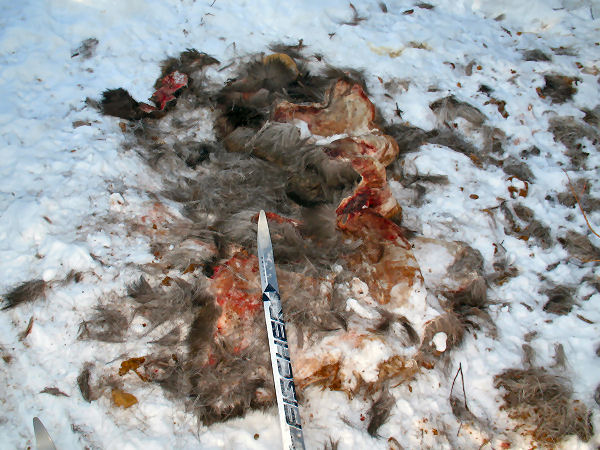
After our fourth day at Windy Gap the swelling in my foot had gone down enough to allow me to put on my boot again; it had also warmed up to a balmy -10 degrees so we packed up and ferried gear and people to the snowmachines we had left at the top of the Fossil Creek drainage. We unthawed our snowmachines and safely returned to our cars, parked near the Tolovana River on the Elliot Highway, but I still remember this trip every winter. When the temperature dips I still feel it in my right foot. My right foot has never recovered from the tissue damage and when the temperature falls below freezing my foot begins to get cold. My wife still doesn’t understand why I wear two pairs of socks on my right foot in the winter, and despite my best attempts my right foot still gets numb. So, at this time of year my foot always takes me back to that frigid evening on Fossil Creek when I realized that I was alone and alive.
Thursday, December 3, 2009
UN: People With Disabilities Face Huge Obstacles

Tuesday, September 15, 2009
The Problems with Special Ed by Jay P. Greene on National Review Online
This is an outstanding article that is worth a read if you get a chance. Although I don't want to totally agree with everything Dr. Greene says here, I do believe he has a point and I am a strong advocate for redefining the IDEA disability categories and revisiting programs for underprivileged and at-risk students.
Shared via AddThis
Monday, September 7, 2009
Elevator Pitch and Blog Focus
The first challenge is an attempt to define the focus of this blog. Although I know the title indicates that the blog is focused on Disability Studies at UI, I'm not so sure that's what I want it to be...so, I'm going to try this elevator pitch method to define my focus.
So, here's my rough draft: "Disability Studies at the University of Idaho provides thought-provoking content and ideas on creating inclusive communities for scholars and everyday people...because inclusion means everyone!"
What do you think? Too cheesy? Too short? Too broad? Feedback is much appreciated!
Thursday, June 18, 2009
More Thoughts on Inclusion
What we need to address is how we prepare school administrators and teachers to change the system from within. Too often our teacher and administrator preparation programs merely reflect the current realities of "schooling" in America, and by focusing on those realities they inadvertently replicate them. We need a new model of personnel preparation that develops teachers and leaders who are skilled at bringing the community, culture, and context into the classroom; thereby acknowledging the interdependence and, paradoxically, the individuality of the students. Schools should not be "liminal spaces" suspended between hegemonic values and individual students' cultural identities. We need teachers and administrators who can create spaces that value students' "place" in the world while also giving them the tools to navigate and, if possible, recreate the hegemonic ideals that promote exclusion and cultural homogeneity.
It's still pretty rough, but I think it gets the idea across...your thoughts?
Tuesday, April 14, 2009
My Comments on Inclusion as a Discussant in Today's Session on Creating Inclusive Schools
“Inclusion, much more than integration or mainstreaming, is embedded in a range of contexts—political and social, as well as psychological and educational—in noting that inclusive education is more that simply “integration”, it is important to stress that inclusive education is really about extending the comprehensive ideal in education. …[we should be] less concerned with children’s supposed ‘special needs’ and more concerned with developing an educational system in which equity is striven for and diversity is welcomed.” (Thomas & O’Hanlon, 2004). Certainly all the papers in this session agree on this point. Thankfully we’re all talking about changes within the system, which would seem to indicate that the various student populations discussed in these papers have been “integrated”—meaning that there is some level of acceptance of “these students” within the current educational context—but I think we can all agree that we are still some ways away from genuine “inclusion”…and so the question becomes how do we take the narratives, data, and insights from the research presented today to guide us in reaching that next level?
One of the major challenges to inclusive schooling is that we have an educational system that is based upon an acultural, technocratic ideal that has evolved minimally since the industrial revolution…certainly the facades have changed but the underlying structure and ethos have remained largely the same…rooted within hegemonic Western ideals of progress, homogeneity, and technical rationality…ideas that do not mesh well with diverse cultures, learners, families, or communities.
Schooling as a neutral, “acultural” and “apolitical” phenomenon is a fallacy and destructive to inclusive teaching…students whose individual identitied are suspended in a liminal political or legal space cannot possibly contextualize their learning on their own…because is many cases there is no context…schools need to create the context for learning…not deny it…
Sometimes the only way to get the hegemonic technocracy to acknowledge diversity and personal needs is to “resist” as pointed out by Kathleen Kosobud…now this is not sabotage of the educational process…it is constructive resistance that pushes the system outside of its tendency to homogenize, if just momentarily. Resistance in the form of narrative is certainly one means of making change, but as we see in Kathleen’s work, and as I’ve seen in my own work, parents, students, and advocates occasionally have to throw themselves upon the gears of the machine to get it to stop and acknowledge their individuality…and it is in this inability of the system to see the individual that a lo
Within the realm of research we deal with an interesting phenomenon with regards to this type of research. We study and advocate for inclusion and yet through the process of our study and advocacy we frequently end up highlighting the differences that are cited as the basis for segregation and marginalization in the first place. In the case of SNO’s and paraprofessionals, they play a valuable and irreplaceable in the CURRENT system, and yet the need for this particular role in schools is indicative of a much broader systemic issue for which the paraprofessional is just a band-aid. They help marginalized students navigate the system that marginalized them in the first place, calling attention to the students who need their help in the first place and thereby creating an additional social perception that the student is different and outside of the “normal” classroom community. “Integration” cannot be accomplished while simultaneously calling attention to difference. This is an extremely difficult balance to strike in the U.S., and an even more daunting task in Asia. Having worked in Taiwan with people with disabilities for several years I understand the stigma and overwhelming social barriers that families and individuals with disabilities face when trying to achieve some semblance of a normal life. As paraprofessionals in Singapore I can completely understand the struggle to identify oneself between competing political and social demands…one to maintain, the other to disrupt.
We are clearly all seeing educational systems that have an tremendous amount of institutional inertia behind them; the educational systems have incestuously reproduced professionals and administrators who, either knowingly or unknowingly, are trained to help the system maintain status quo, and the status quo that our systems maintain, as pointed out earlier is based upon an outdated and hegemonic ideal that is inscribed within the classroom, the school, and the entire educational industry. The school is too often removed from the day-to-day cultural existence of the students…so the culture of the students’ homes, neighborhoods, and communities need to be brought more into the school. I certainly think that the historic review of the James Adams Community Schools certainly has a lot to commend for future educational thought. Just as we are seeing an explosion in the locovore and organic gardening movements as local action-based remedies for global warming, so too do I think we need to look at a “back-to-basics”, community-centered approach to address global learning in local contexts.
Inclusion doesn’t just happen in the school…inclusion is a holistic construct that must also encompass community. Several years ago while I was helping develop a self-advocacy skills curriculum for students with disabilities in Alaska, I had the opportunity to visit a remote school in Interior Alaska that served a community of Yupik Eskimos on the vast alluvial plains of the Yukon River. Having worked with students with disabilities for 7 years prior, I had very clear expectations for how the students with disabilities would be treated at this school. In most schools that I had been in, students with disabilities were segregated; formally by attending separate “special” classes, and informally in social situations by their peers were uncomfortable around a student who was “different”.
As I spent time in this particular rural school I noticed that the students with disabilities were not viewed as separate by their peers and were not taught in segregated classrooms. They were hanging out with friends, eating lunch together, and walking to and from school together. On the surface, it appeared that for all intents and purposes the students with disabilities in this school were not viewed as “different” or “disabled” by their peers.
After school let out for the day, I found an opportunity to briefly talk with a group of boys leaving the school. I said to the group: “I noticed that you guys have a few friends who are different, do you hang out with them when you are at home too?” The boys looked at me quizzically, and I queried them more directly: “Why do you hang out with the kids with disabilities?” The boys thought about that for a brief second and then the eldest one of the group looked me straight in the eyes, an uncommon and confrontational gesture in Yupik culture, and said: “Because they’re one of us.” In this one statement lies the “esprit de corps” discussed by Christine and Travis, but it is much more…it embodies an ethic of interdependence that doesn’t see diversity or difference as threatening but vital to the cultural richness of the local community…it sees the success of the classroom, school, and community as hinging upon the success of its individuals and vice versa...